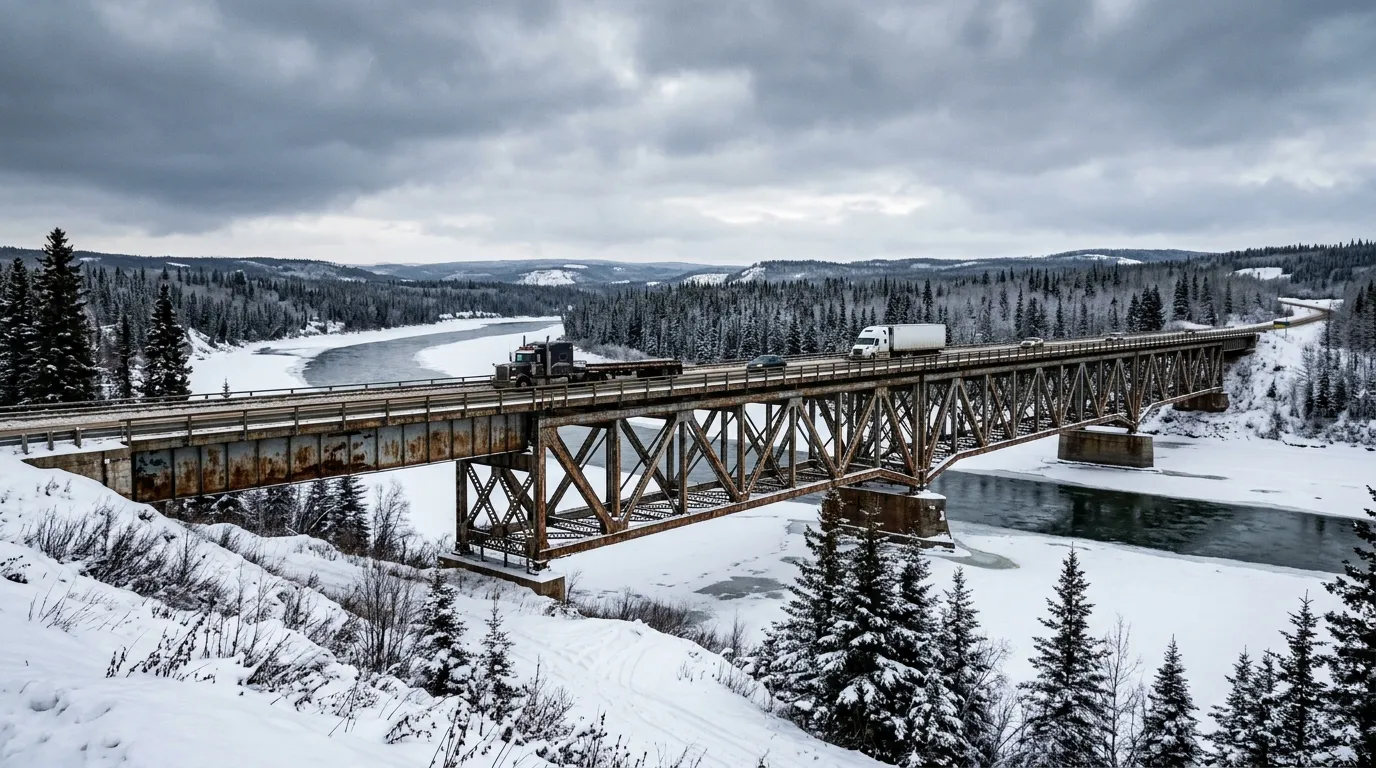
Community groups and local leaders in Dawson Creek, British Columbia, are increasing pressure on the provincial government to fully replace the 65-year-old Taylor Bridge, citing concerns that planned repairs are insufficient to maintain a vital transportation link.
The Independent Contractors and Businesses Association recently released inspection reports obtained through a Freedom of Information request, which highlight significant structural issues with the bridge spanning the Peace River on Highway 97. According to the reports, the bridge features cracked steel floor stringers that have required repeated welding, corroded steel connection nodes, and a failing protective coating system.
The bridge serves approximately 7,500 crossings daily, with nearly one-third of that traffic coming from commercial vehicles. The route is considered essential for the oil, gas, forestry, and agricultural industries, and it supports 20% of all over-weight and over-width traffic moving through the province, according to the Ministry of Transportation.
Advocates warn that if the bridge were to close or face significant weight restrictions, drivers would be forced to take an alternate route that adds 175 kilometres to their commute, turning a one-hour trip between Dawson Creek and Fort St. John into a journey of over three hours. Critics argue that the provincial government’s current plan appears to favour continued maintenance and rehabilitation over a permanent replacement.
While the Ministry states it is working on a long-term solution and has already completed pile-load testing, the Fort St. John and District Chamber of Commerce notes that the primary barrier remains the estimated $1 billion cost of a new structure. Local politicians, including Peace River North MLA Jordan Kealy and Peace River South MLA Larry Neufeld, have publicly called for a firm construction timeline, stating that residents have been promised a new bridge for over two decades.
The District of Taylor is currently supporting an advocacy campaign urging the province to prioritize the project. As of 2026, the government reports that land acquisition for the project is underway, with additional soil and archaeological work planned for the coming year.