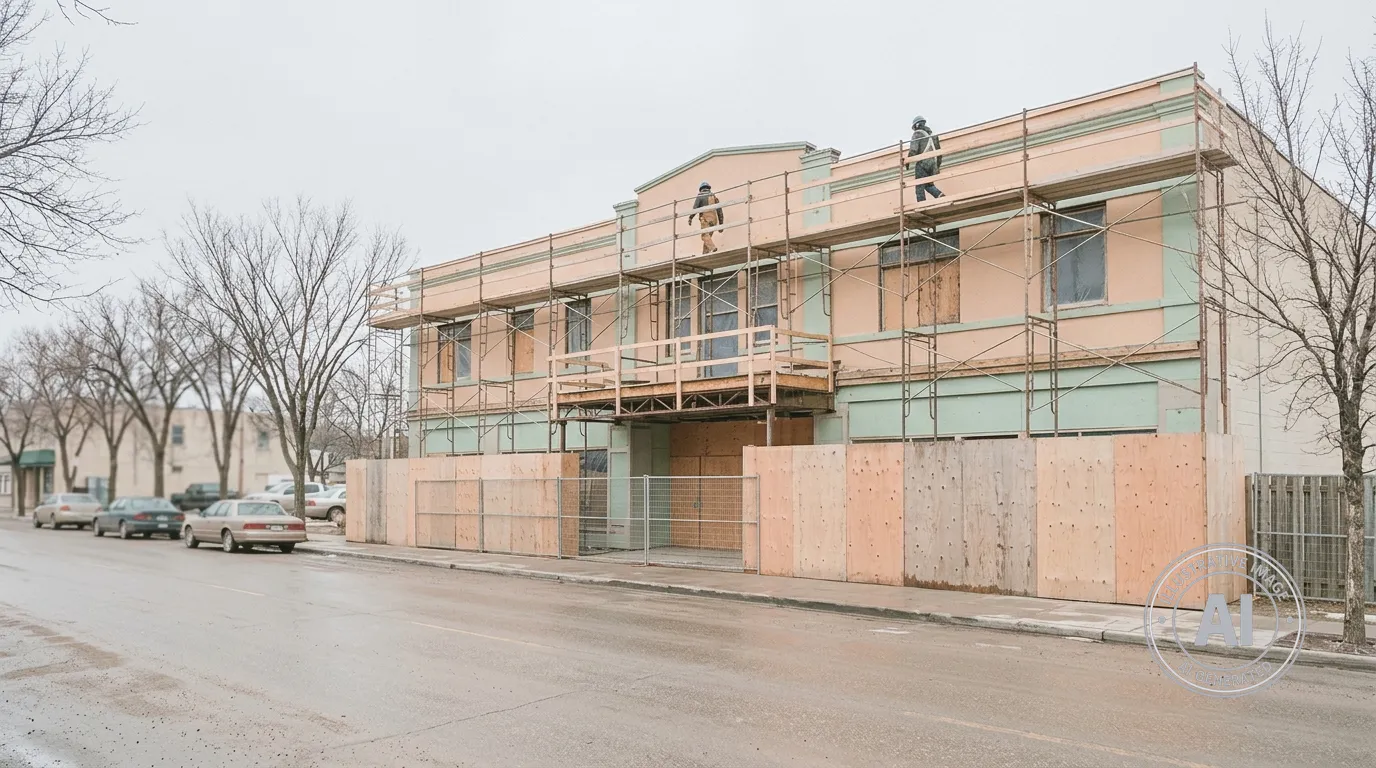
Selkirk City Council has officially appointed a new community-led board to manage the future of the Garry Theatre, marking a major step toward reopening the historic downtown landmark. The 11-member board was appointed on February 17, 2026, and held its first meeting on April 15 to begin the work of transitioning the facility into an independent, non-profit organization.
The City of Selkirk purchased the theatre for $350,000 in August 2021, shortly after the previous operator, Landmark Cinemas, closed the doors following 73 years of business. Since the purchase, the city has pursued a plan to revitalize the building as a community-focused cultural venue. While renovations on the site began in March 2025, the project is currently running about six months behind the original timeline due to unexpected construction challenges involving the building’s foundation and material delays.
The new board includes President Duane Nicol, Vice-President Bernadette Preun, Secretary Kyla Ray, and Treasurer Matt Evans, alongside members Alfred Anderson, Greg Dewar, Jamie Horyski, Jana Pringle, Neil Cooke, Neil Kordalchuk, and Sarah Hodges-Kolisnyk. To ensure a smooth transition from city oversight, both Nicol and Ray have been appointed to the board for a one-year term. For Evans, the role is a return to a familiar setting; he previously managed the theatre from 2007 to 2012.
The board is now moving quickly to prepare the venue for its return to the community. A primary focus for the new leadership is currently the hiring of an Executive Director to oversee day-to-day operations. The Garry Theatre, which first opened in 1948, remains a significant piece of local history, having survived a major fire in 1954 before being rebuilt and continuing operations for decades.
Mayor Larry Johannson has described the project as a generational investment in the city’s downtown and its arts and culture scene. The restoration is supported by a total project budget of approximately $2 million, gathered through contributions from the Province of Manitoba, the Arts, Culture and Sport in Community Fund, and a local fundraising campaign that raised over $186,000 from residents.