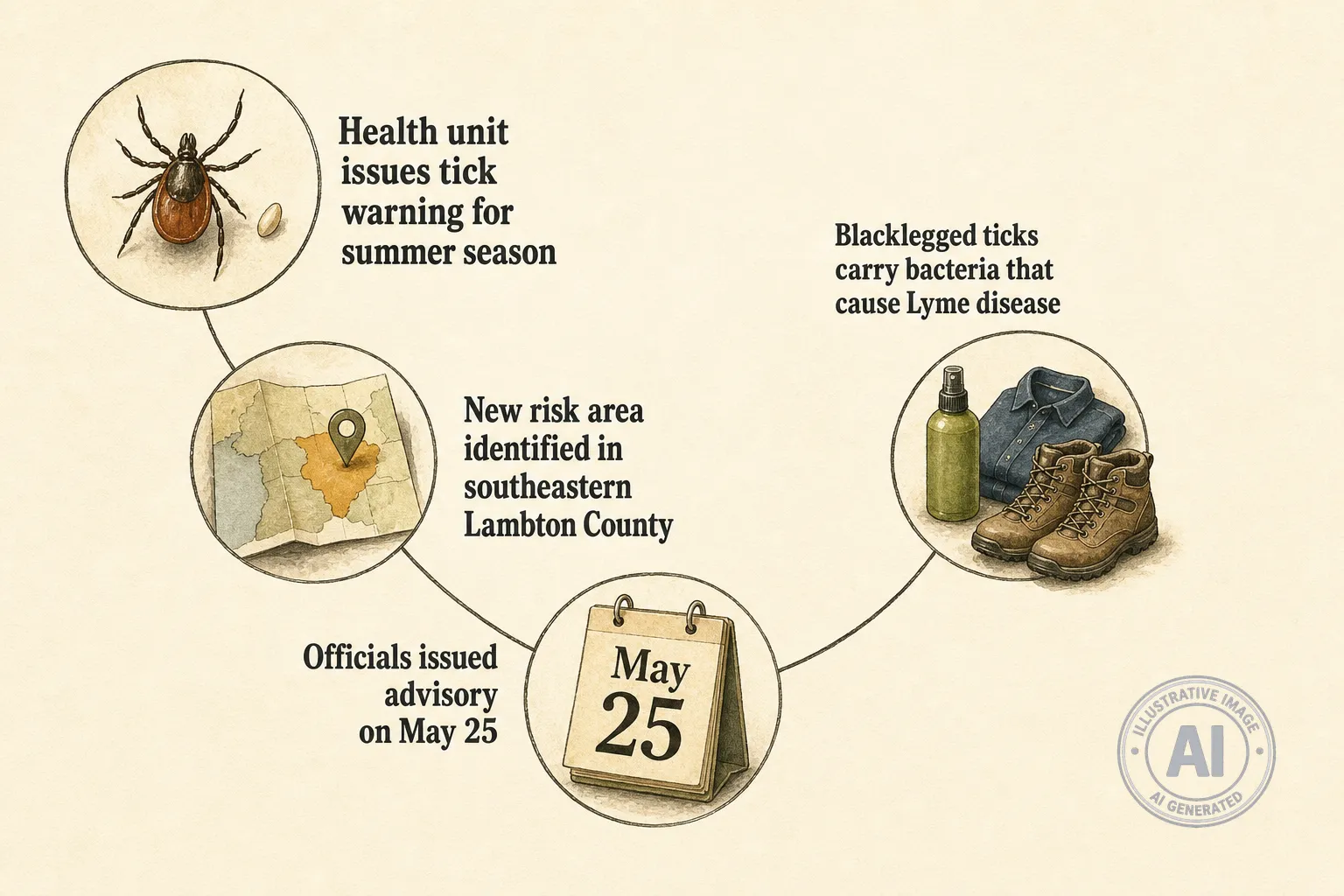
Lambton Public Health is urging residents to protect themselves against blacklegged ticks as warm weather settles in, with two local areas now flagged as higher risk for Lyme disease.
The health unit posted a warning on May 25, 2026, reminding everyone that tiny blacklegged ticks, which can carry the bacteria that cause Lyme disease, are already active. Officials have identified a new risk area in southeastern Lambton County, expanding the known zone beyond the long-standing Pinery Provincial Park and a 20-kilometre radius around it, including Port Franks.
“Lambton Public Health continues to see significant increases in the proportion of blacklegged ticks submitted for identification,” the health unit said in its release. The southeastern zone was discovered through tick-dragging surveillance done in partnership with neighbouring health units in Chatham-Kent and Middlesex-London.
In Lambton County, eight confirmed cases of Lyme disease were recorded in 2025, according to a Lambton Public Health report, down from nine the previous year. The health unit classifies the region as “emerging” for the disease. Across the province, Public Health Ontario counted 2,930 confirmed and probable cases in 2025, continuing a years-long rise in tick-borne illness.
Past monitoring shows how established the threat has become locally. In fall 2021, staff dragged for ticks at Pinery Provincial Park and collected more than 150 blacklegged ticks. Of those, 38 percent tested positive for the bacteria causing Lyme disease, the highest infection rate ever found there.
Blacklegged ticks are about the size of a sesame seed, slow-moving, and prefer wooded areas and fields. The larger American dog tick, common in Lambton, does not spread Lyme disease. Health officials stress that the risk of infection climbs sharply if a tick stays attached for more than 24 hours.
The health unit recommends using insect repellent, sticking to trails, wearing long sleeves and pants, and doing a full body check after being outdoors. Symptoms like fever, headache, muscle pain, fatigue, or a red bullseye-shaped rash can appear days to a month after a bite and need prompt medical attention.
Residents can have ticks identified for free through eTick.ca, a national service run by Bishop’s University. For more information, contact Lambton Public Health at 519-383-8331 ext. 3812.