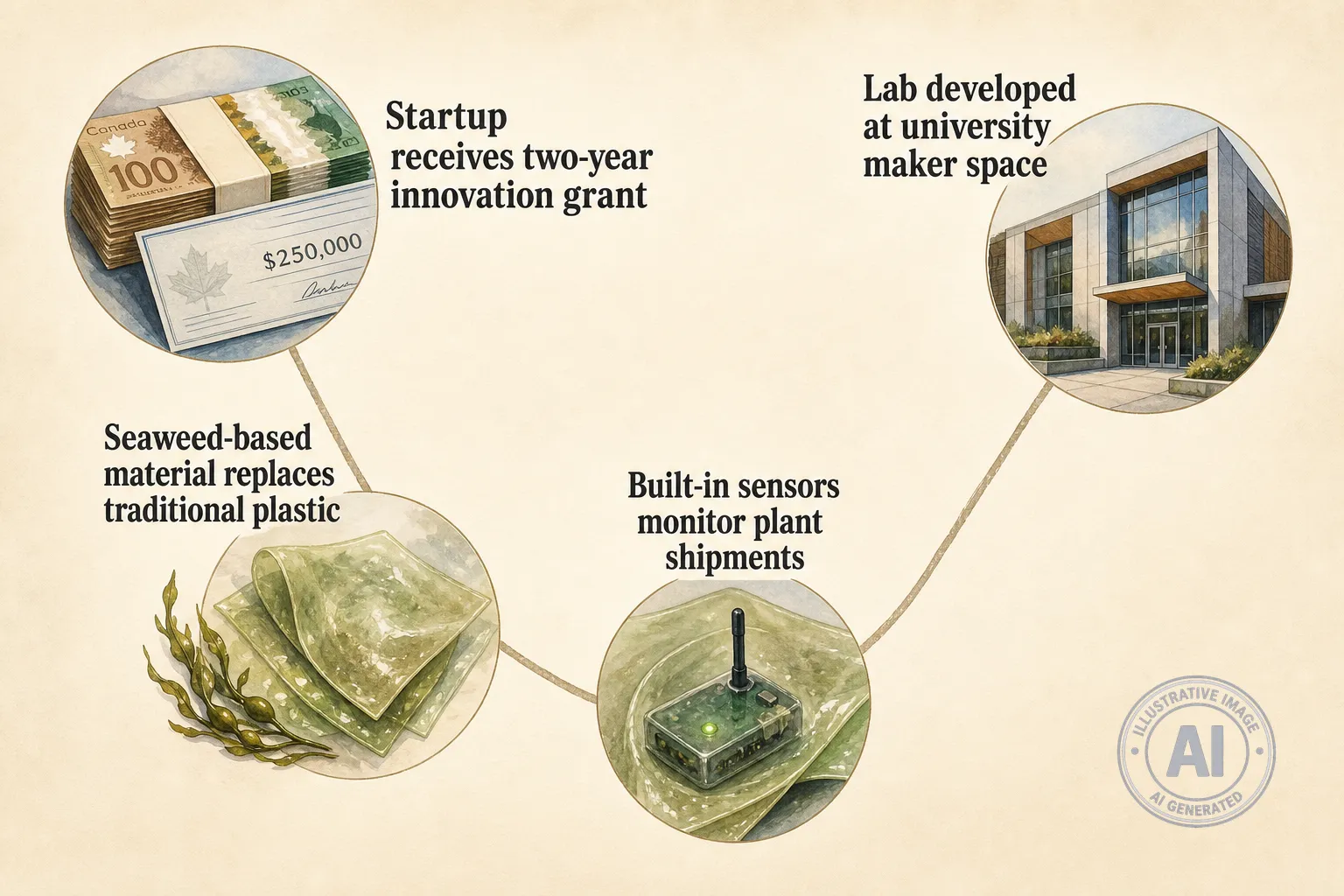
A Lethbridge startup has secured $250,000 to create biodegradable packaging that can keep a watchful eye on live plants during shipping. Anandi Botanicals Inc. received the two-year Innovation Catalyst Grant to develop seaweed-based materials with built-in sensors, a project that could eventually change how perishable goods travel across Canada.
Dr. Annie Ray, a University of Lethbridge graduate with a PhD in plant biology, founded the company after spending more than a decade in the plant tissue culture industry. She noticed that while sensors are available to track conditions like temperature and humidity, no one had put them together into a simple, practical system for plant shipments.
“I have been working in the plant tissue culture industry for more than a decade and observed a gap in shipment tracking for plants,” Ray explained. “While sensors can be purchased separately to monitor shipment conditions, they are not integrated into a simple system for plant shipping.”
Ray first tested the concept with ordinary plastic packaging, and it worked. But she wanted something that would not add to the world’s waste problem. “We tried it with plastic packaging first and it worked wonderfully but we wanted something biodegradable, so we started talking with companies that used seaweed as plastics,” she said. The result is a packaging material that breaks down naturally, unlike traditional plastic.
The technology is being developed at SynBridge, a synthetic biology maker space at the University of Lethbridge where Anandi Botanicals leases lab space. The Innovation Catalyst Grant is administered by the University of Alberta, University of Calgary, and University of Lethbridge, with oversight from the Government of Alberta’s Ministry of Technology and Innovation.
Nate Glubish, Minister of Technology and Innovation, said the current funding round included twelve early-stage ventures across the province. “Alberta is full of brilliant people with ideas worth backing,” he said. “This cohort is proof the model is working. Twelve early-stage ventures, twelve reasons for the next generation of Alberta innovators to bet on this province.”
While the immediate focus is on helping greenhouses, nurseries, and growers receive virus-free plants in better condition, Ray said the potential reaches far beyond horticulture. “This is not only restricted to the plant industry, but it could also be used for food and beverage, perishables, as well as pharmaceutical industries,” she said. “This is only a start.”
Luc Roberts, who manages the grant program locally as an entrepreneurial strategist at the University of Lethbridge, said the funding is designed for recent STEM graduates with big ideas but limited business connections. “This grant supports the recipient with not only a salary as well as seed funding, but a network of mentors, peers and innovation ecosystem partners to help them,” he said.