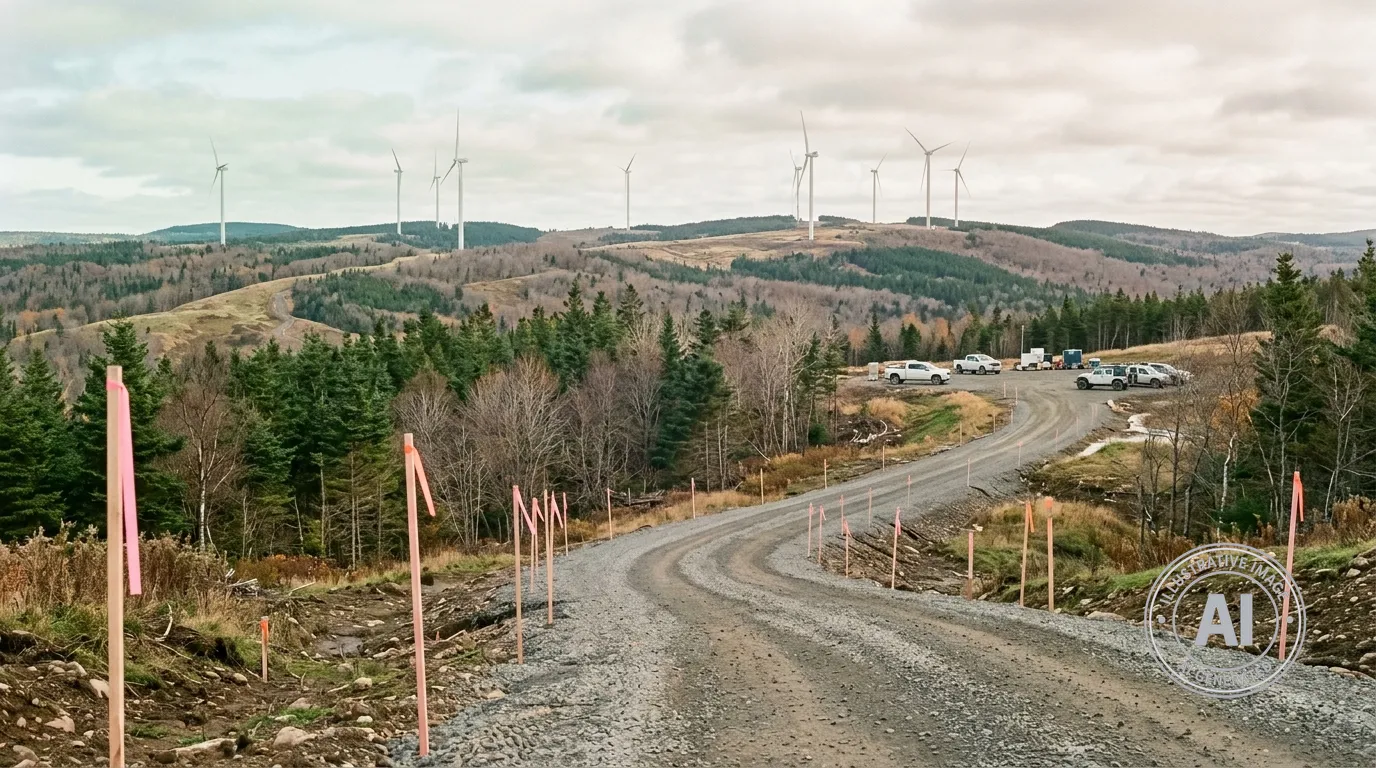
The provincial government has officially approved the environmental assessment for the Eigg Mountain Wind Farm in Antigonish County, paving the way for the 22-turbine project to proceed. Environment and Climate Change Minister Tim Halman granted the approval on April 9, 2026, after determining that potential environmental impacts could be managed through a strict set of 57 terms and conditions.
Developed by Renewable Energy Systems Canada in partnership with the Paq’tnkek and Pictou Landing First Nations, the wind farm is set to be built on private land near Connors Mountain Road. The project is part of the province’s Green Choice Program, which aims to significantly increase the amount of clean electricity available in Nova Scotia.
For the local community, the development is expected to bring a boost in employment. Construction is set to begin in late 2026 and is projected to create between 200 and 250 jobs during the building phase. Once the farm is operational in 2028, it is expected to provide long-term employment for 4 to 12 people over its 35-year lifespan. Additionally, the Municipality of the County of Antigonish will receive an estimated $1.3 million in annual tax revenue from the project.
The wind farm will generate approximately 154 megawatts of electricity, which is enough to power about 49,280 homes. Officials state the project will also help reduce provincial greenhouse gas emissions by roughly 271,000 tonnes annually, an amount equivalent to removing over 58,800 gas-powered vehicles from the road.
While the project has moved forward, it has faced opposition regarding its proximity to local wildlife habitats. The Moose Conservation Association of Nova Scotia submitted a formal objection on March 24, 2026, citing concerns about the wind farm’s location next to the Eigg Mountain/James River Wilderness Area and its potential impact on the endangered mainland moose. In response to these concerns, the provincial approval includes mandatory requirements for wildlife management plans and ongoing surveys of mainland moose populations to ensure the environment is protected as the project develops.