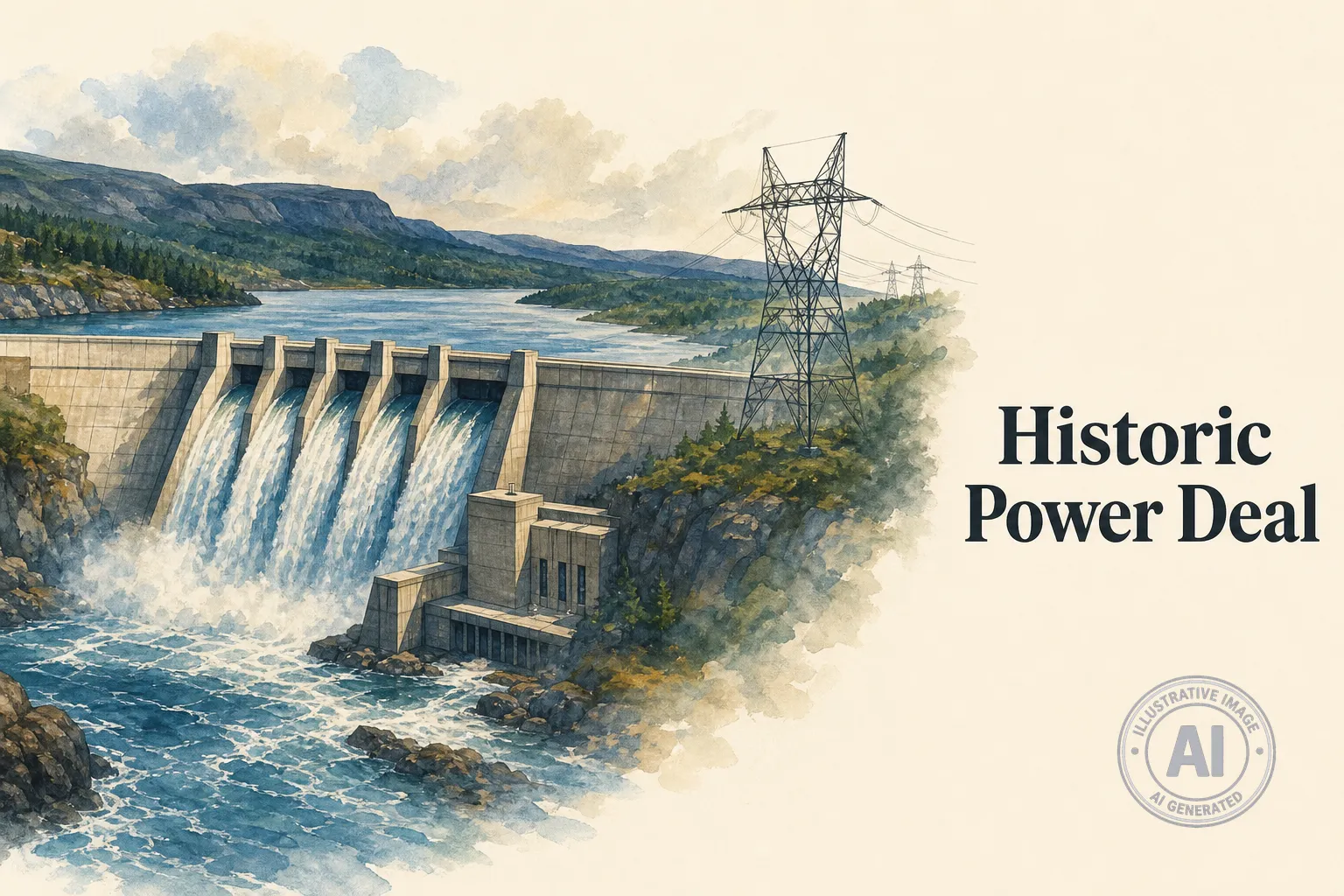
Bay Roberts, NL – Newfoundland and Labrador, along with the federal government and Quebec, has signed a landmark agreement to develop Churchill Falls and Gull Island, in what is being called the largest clean energy investment in North American history. The deal, announced on August 17, 2026, promises to reshape the province’s electricity landscape for decades, with direct impacts on power rates and grid reliability for residents and businesses in communities like Bay Roberts.
Premier Tony Wakeham, Prime Minister Mark Carney, and Quebec Premier Christine Fréchette signed the Definitive Cooperation and Implementation Agreement, valued at nearly $70 billion. The federal government is providing $10 billion in financing to upgrade and expand the Churchill Falls generating station and build the new 2,700 MW hydroelectric facility at Gull Island. The total financial benefit to Newfoundland and Labrador is valued at $49 billion, up from the $36 billion in the previous 2024 agreement.
For Newfoundland and Labrador residents, one of the most immediate benefits is the Churchill River Electricity Rebate. Once the binding agreements are finalized, the province will introduce a 15 per cent rebate for all residential ratepayers on their first 2,000 kWh of electricity usage per month, saving an average of $351 per year. This comes after residential electricity rates increased between 1.3 per cent and 2.25 per cent effective July 1, 2026, so the rebate will help offset those costs.
The agreement also ends the controversial 1969 Churchill Falls contract, which allowed Hydro-Québec to buy electricity at 0.2 cents per kWh and sell it at market rates, causing decades of resentment in the province. Under the new deal, Newfoundland and Labrador will retain up to 2,350 MW of electricity from Churchill Falls and Gull Island, 360 MW more than the previous agreement, plus 400 MW from a new wind project. The province has also secured guaranteed transmission access totaling 985 MW to sell power to U.S. markets through Quebec.
The projects will generate 14,000 megawatts of clean power, support 23,000 jobs during construction, and contribute $31 billion to Canada’s GDP through the early 2040s. The deal guarantees that 85 per cent of all person-hours of employment in constructing Gull Island will stay within Newfoundland and Labrador, with priority given to Labrador Innu, Labradorians, and Newfoundlanders. Up to 5,000 workers are expected at peak construction.
According to Newfoundland and Labrador, the agreement represents a significant improvement over the 2024 Memorandum of Understanding, which an independent review committee had found was not in the public interest. The new deal gives the province more value, more power, and more control over its energy future. For Bay Roberts and other communities across the province, the agreement is expected to bring more stability to the electricity grid and open up new opportunities for industrial growth and long-term economic benefits.