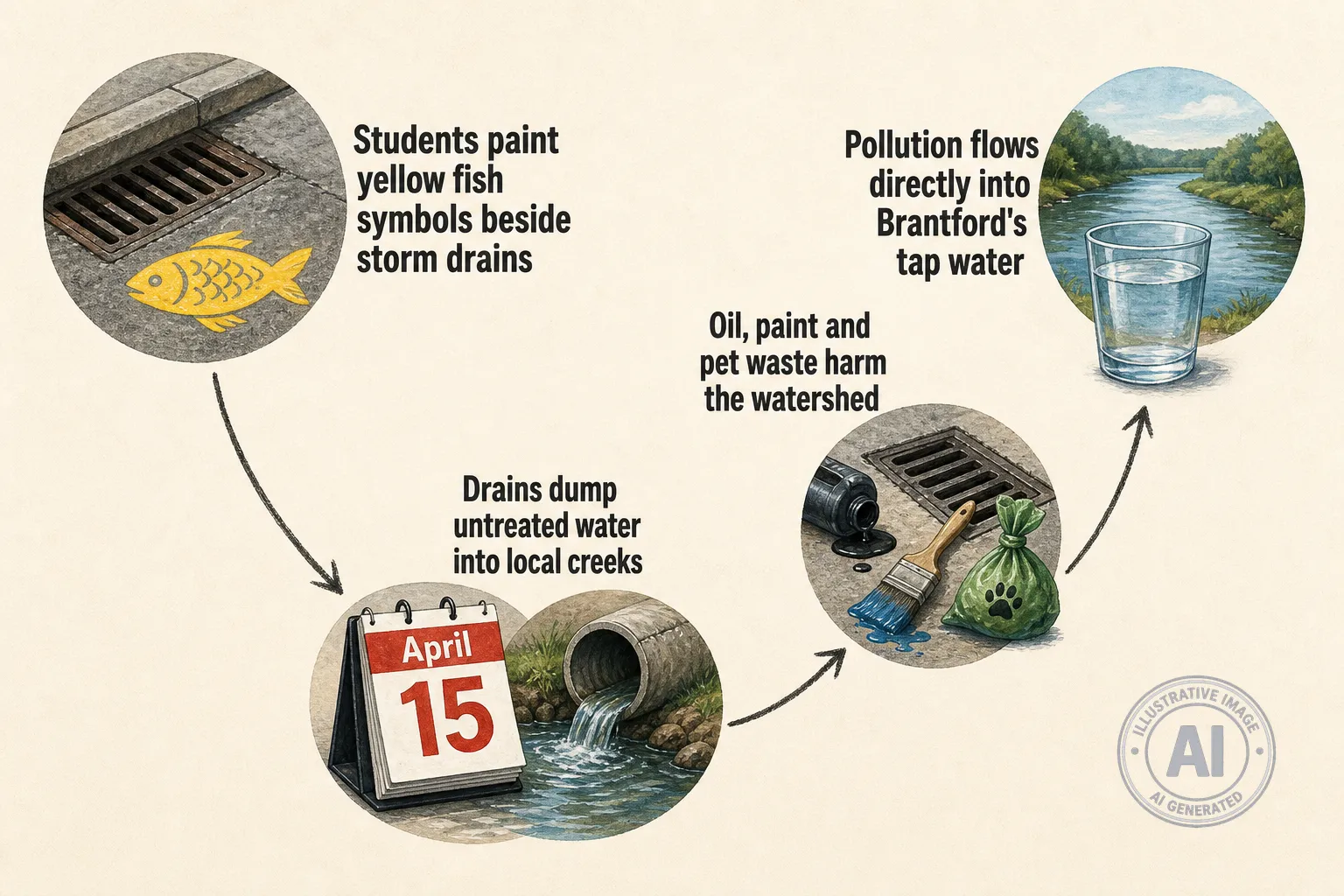
Students from Pauline Johnson Collegiate in Brantford, Ontario, have been participating in the Yellow Fish Road Program for years, painting bright yellow fish next to storm drains and handing out brochures with a simple warning: anything that runs into the gutters ends up in local waterways — and ultimately the drinking water.
Through the Yellow Fish Road Program, a national initiative developed by Trout Unlimited Canada in 1991, teens in the school’s E3 (ecology, environment and education) program have marked catch basins with fish symbols and the words “Rain Water Only.” The message is that unlike water going down sinks and toilets, stormwater flows directly into local creeks, Mohawk Lake, and eventually the Grand River — the same river that supplies Brantford’s tap water.
During one of the annual outings, students distributed door hangers warning that none of Brantford’s storm drains go to the wastewater treatment plant. Anything poured into catch basins — oil from a leaky car, leftover paint rinsed off a brush, pet waste from a lawn — drains untreated into the watershed. The City of Brantford lists cooking grease, motor oil, gasoline, used water softener salt, paint, animal droppings, and lawn and garden waste as materials that should never enter storm drains.
Science teacher Tom Sitak, who coordinates the E3 program at Pauline Johnson, said the students themselves designed the stencils and door hangers used during the outreach. As of 2019, over four years of the program had resulted in more than 500 catch basins in the neighbourhood around the Colborne Street high school being marked.
The effort is part of a wider push by the city to manage $383 million in stormwater infrastructure and keep the Grand River watershed clean. Officials note that because the river doubles as the community’s drinking water source, preventing pollution at the street level is a public health priority.