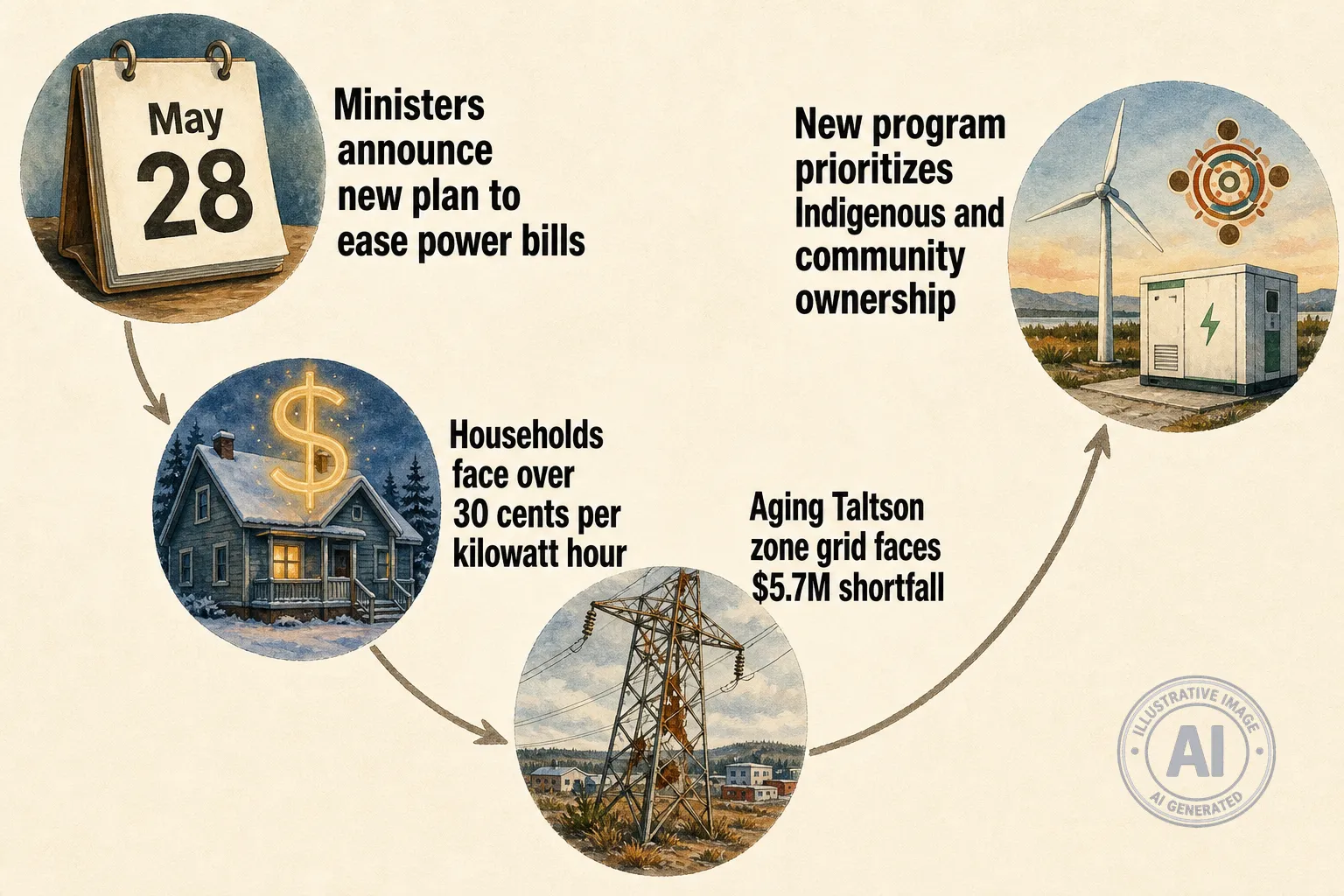
The Government of the Northwest Territories announced new plans on May 28, 2026, to tackle high power bills and aging infrastructure across the territory, including Hay River, where residents have faced some of the steepest electricity costs in Canada.
Infrastructure Minister Vince McKay and Strategic Infrastructure, Energy and Supply Chains Minister Caroline Wawzonek said the changes build on 11 policy directions already issued to the Public Utilities Board in April 2025. Those directions call for long-term electricity planning, more renewable energy in diesel communities, and a fairer rate system.
“Across the Northwest Territories, residents, businesses, and communities are facing real pressures when it comes to electricity, including rising costs, aging infrastructure, and the need to modernize how our system operates,” McKay said in a statement.
Households in the NWT and Nunavut pay more than 30 cents per kilowatt hour, compared to the Canadian average of about 12.9 cents, according to a Canada Energy Regulator analysis. Without $45.2 million in GNWT subsidies over the past two years, rate increases would have approached 45 percent. In the Taltson zone, which serves Hay River, rates cover only about 75 percent of costs, leaving an annual shortfall of $5.7 million.
One key part of the plan is Integrated Power System Planning, which aims to create a coordinated, territory-wide approach to electricity decisions. Utilities are now leading engagement with communities and Indigenous governments, and that input will shape how the system evolves.
The 2025 directions also raised renewable energy caps in diesel-powered communities from 20 percent to 30 percent, with more flexibility if battery storage is used. A new Independent Power Producer program will prioritize Indigenous and community ownership and make power purchase agreements more transparent.