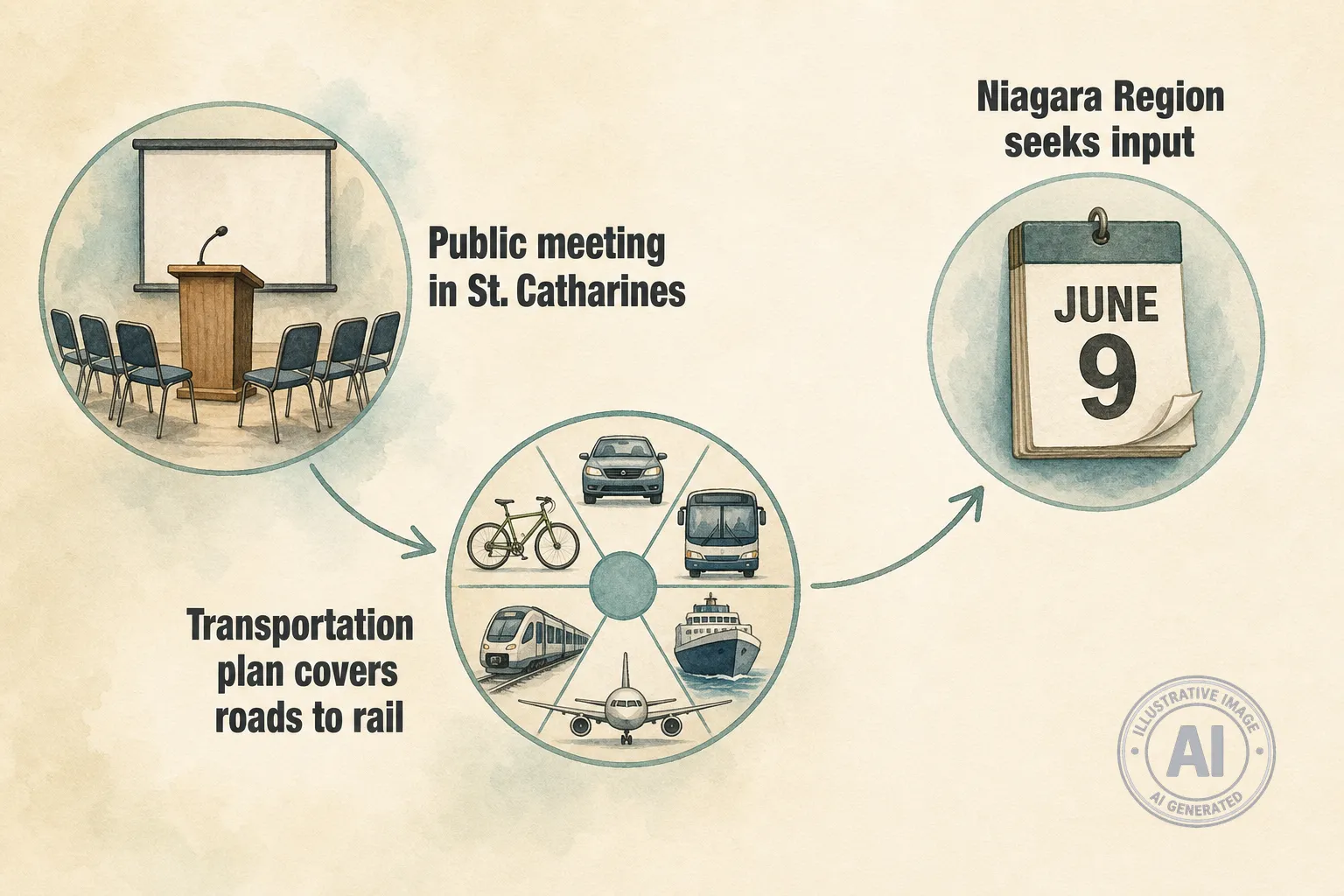
Residents across all 12 Niagara municipalities, including Port Colborne, will have their first chance to weigh in on long-term transportation plans at a public meeting in St. Catharines on June 9. The Niagara Region is hosting the session to gather feedback on an update to its Transportation Master Plan, which will guide roads, transit, cycling, walking, marine, rail, air, and border infrastructure through 2051.
The drop-in style information centre runs from 5:30 to 7:30 p.m. at the Seymour-Hannah Sports and Entertainment Centre in the Meridian Room. A second session follows on June 10 at the Welland Community Centre. Staff and consultants will present early findings and answer questions, but the main goal is hearing what matters most to residents.
With Niagara’s population projected to grow from about 478,000 to nearly 700,000 by 2051, the region needs a strategy that keeps people and goods moving. The updated plan will look at all modes of travel, including roads, marine, rail, air, and border connections, alongside local transit and active transportation.
Port Colborne Councillor Vance Badawey says the work is overdue. “Niagara’s transportation networks are a core economic strength,” he said, adding the region isn’t “fully capitalizing on its assets which underpin trade, investment and tourism.” He pointed to Thorold’s multimodal hub as an example of revitalization done right.
However, some councillors worry about the price tag. The plan update costs roughly $1.5 million, with nearly $1 million paid to consulting firm WSP Canada Inc. Regional Chair Bob Gale has questioned whether the region can afford to study everything, saying, “I get concerned that we’re spreading ourselves too thin… we’re broke,” while Fort Erie Councillor Tom Insinna noted many current roads are already “in disrepair, poor or very poor condition.”
Diana Morreale, the region’s director of growth management and planning, said the plan will include detailed population modelling and help identify when capital budgets are needed and how to fund them. The study follows Ontario’s Municipal Class Environmental Assessment process and is expected to wrap up by fall 2027, with more public sessions planned before then.