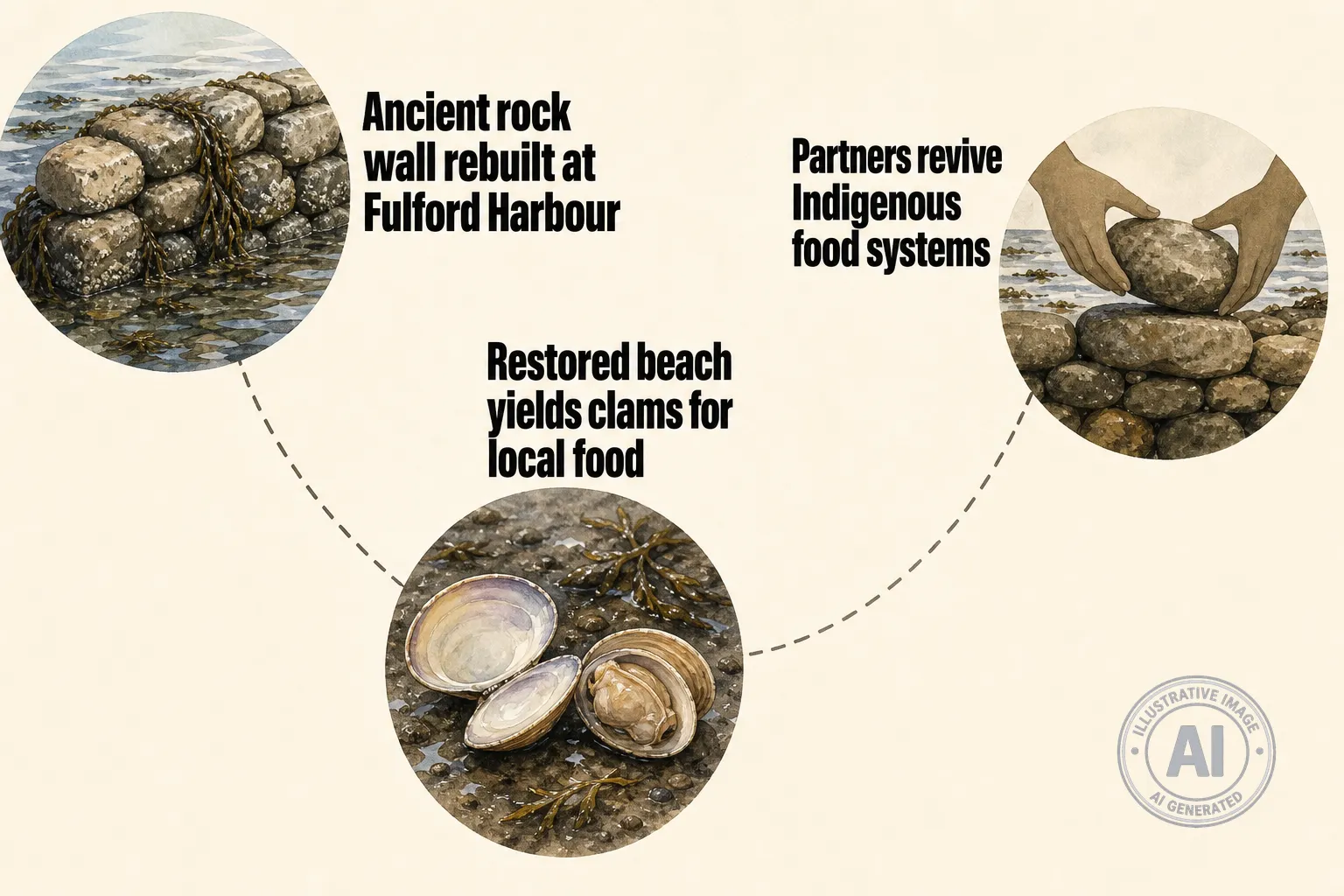
A 4,500-year-old rock wall at Fulford Harbour on Salt Spring Island is slowly returning to its traditional role as a food-producing sea garden, thanks to a growing partnership between local First Nations, the Salt Spring Island Foundation, and Parks Canada.
The Fulford Sea Garden, also called W̱EN,NÁ,NEĆ or Hwnen’uts, was built by Coastal First Nations using sophisticated engineering to trap sediment and create ideal habitat for clams, seaweed, crabs, and kelp. At low tide, an 800-metre rock wall emerges knee-high from the water, stretching 20 metres wide along the shore.
“We don’t have pyramids, we don’t have Mayan temples — we don’t have many of those things that lasted over many lifetimes,” said W̱LC Knowledge Weaver ĆILTEN, also known as Phil Tom. “It’s significant to have history proving that our people were here that long ago.”
The Salt Spring Island Foundation recently highlighted the sea garden in a new community impact story, published May 29, 2026. The story details how the restoration effort is reviving Indigenous food systems and advancing Truth and Reconciliation on the island. It follows the Foundation’s 2026 Indigenous Priorities Grants, which awarded $40,000 to the Salt Spring Island Conservancy for the sea garden project, one of the largest grants in the program’s fifth year. An additional $14,000 went to support Truth and Reconciliation Day events.
The restoration work, led by the W̱SÁNEĆ Leadership Council alongside the Salt Spring Island Conservancy and Parks Canada, has already rebuilt more than 320 metres of sea garden walls and maintained over 11,700 square metres of beach habitat. Volunteers have contributed more than 11,000 hours to the project. Once productive again, the sea garden is expected to support up to twice as many clams as unmodified beaches, drawing in other marine life like herring and salmon.
The project is part of a broader push for Indigenous food sovereignty on Salt Spring Island, recognizing that for generations, colonial policies suppressed traditional harvesting practices and disconnected First Nations from these coastal food systems. By restoring the ancient rock wall and the knowledge around it, the partners hope to strengthen the island’s local food resilience and honour a heritage that has shaped the coastline for millennia.