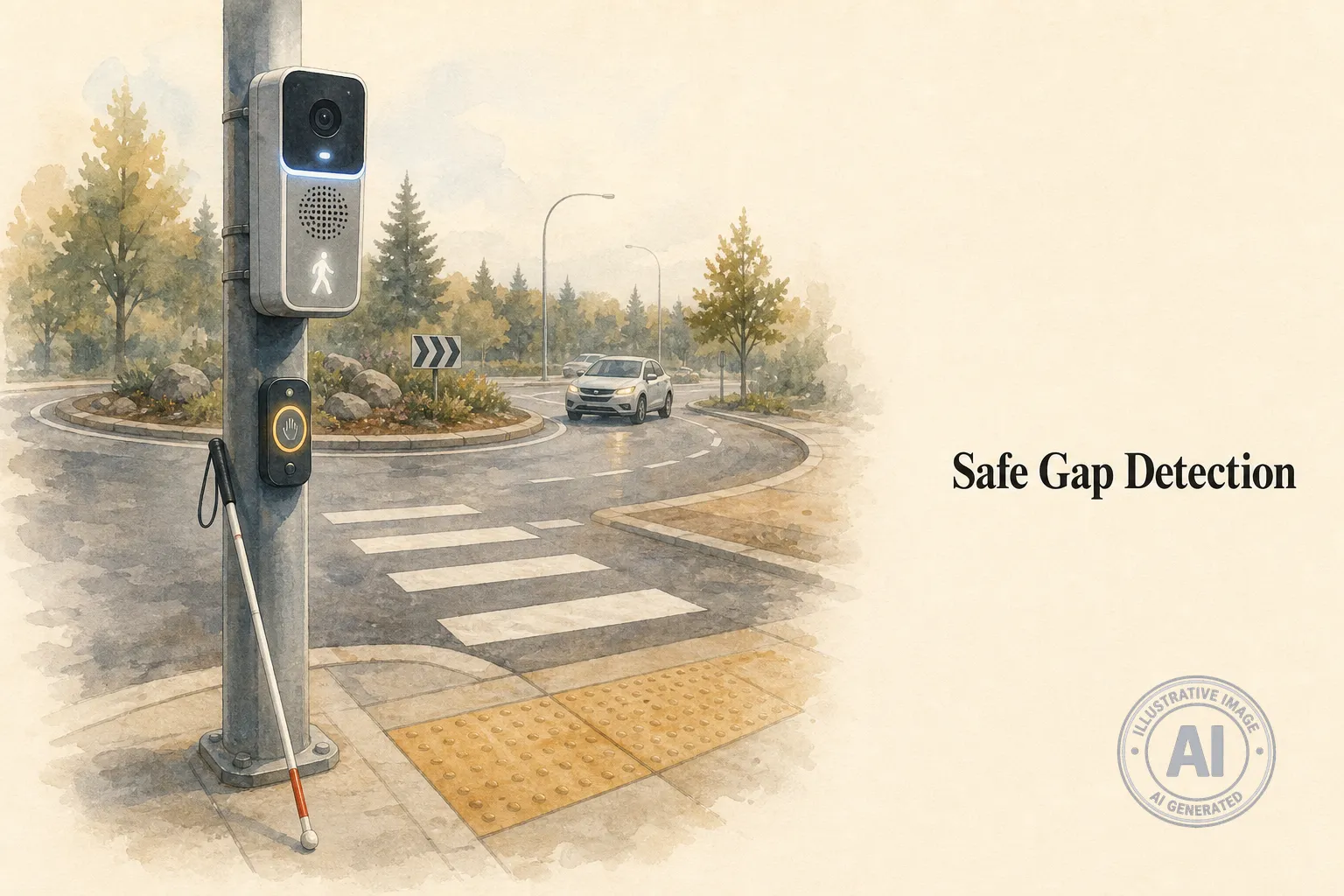
A Lakehead University PhD candidate has developed a sensor-based system that uses artificial intelligence and cameras to help pedestrians with vision loss cross roundabouts safely in Thunder Bay, Ontario.
Omotunde Adeniran, who is supervised by Dr. Juan Pernia and Dr. Sam Salem in the Department of Civil Engineering, created the system to detect approaching vehicles and alert users through a loudspeaker when a safe gap in traffic appears. When activated, it says either “Gap detected, use caution” or “Vehicle approaching.”
The technology was tested at the Edward Street and Redwood Avenue roundabout with support from the City of Thunder Bay and Pioneer Construction. A trial with volunteers from the CNIB was conducted at the site in the summer of 2026.
According to research, about 1.5 million Canadians live with visual impairments, and roundabouts pose significant challenges because they lack standard traffic signals and rely on auditory cues that can be hard to distinguish. The Edward Street and Redwood Avenue intersection has accessibility features on Edward Street but not on Redwood Avenue, making it a useful test site.
Adeniran’s work recently won first place in the 2026 Canadian Association of Road Safety Professionals Student Paper Competition for his paper titled “Field Testing of an Infrastructure-Mounted Sensor-Based Accessibility System for Unsignalized Roundabouts.”
The project aligns with United Nations Sustainable Development Goals related to industry, innovation, reduced inequalities, and sustainable cities.