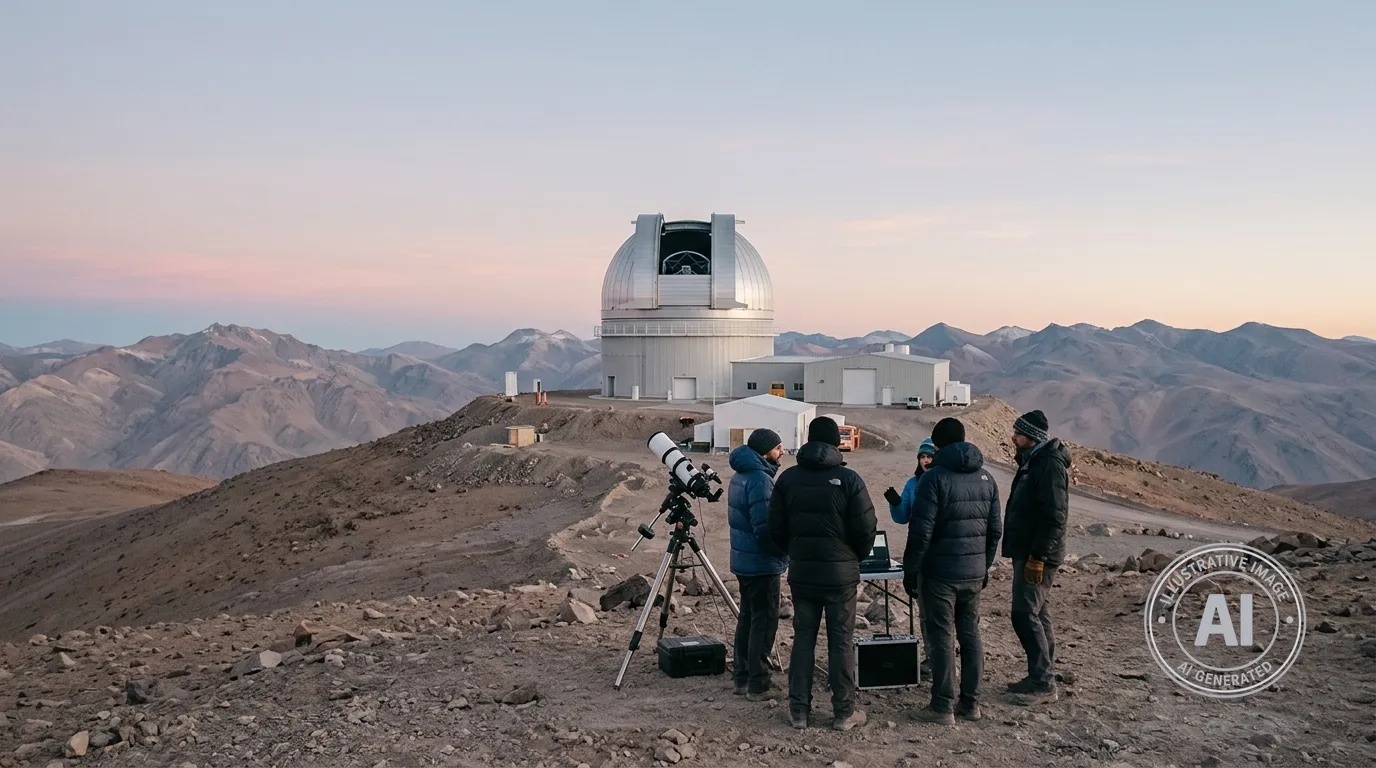
The University of Waterloo is leading a team of Canadian researchers behind a major new telescope that has officially been completed in Chile. The Fred Young Submillimeter Telescope, a 6-metre wide observatory, was inaugurated on April 9, 2026, at the summit of Cerro Chajnantor in the Atacama Desert.
Positioned at 5,600 metres above sea level, the telescope is one of the highest ground-based observatories in the world. Its location was chosen for its exceptionally dry conditions, which allow scientists to observe parts of the light spectrum that are typically blocked by atmospheric water vapour. The project represents the culmination of 34 years of international development.
The University of Waterloo serves as the lead institution for the Canadian side of the project, representing a consortium of over a dozen universities that holds a 20 per cent share in the facility. Dr. Michel Fich, a professor emeritus of physics at the university, has served as the Canadian project leader since 2006. In 2021, a team led by Dr. Fich secured $4.9 million in funding from the Canada Foundation for Innovation to support Canada’s participation in the build.
The telescope is designed to help astronomers study some of the most complex questions regarding the origins of the universe, including the nature of dark matter and dark energy, as well as the evolution of galaxies and the moments immediately following the Big Bang. Its unique optical design will allow for a process researchers describe as celestial cinematography, enabling them to map the sky with high efficiency.
Due to the extreme altitude and thin air at the summit, the construction required significant logistical coordination. The telescope was first fully assembled in Germany to ensure every part fit correctly. It was then disassembled into large pieces—some weighing as much as 60 tons—and transported to Chile by barge and cargo ship, before being trucked up the mountain for final installation.
The inauguration ceremony held on April 9, 2026, brought together more than 100 attendees, including scientists and dignitaries from Canada, the United States, Germany, and Chile. Researchers expect to begin collecting data in the coming months.