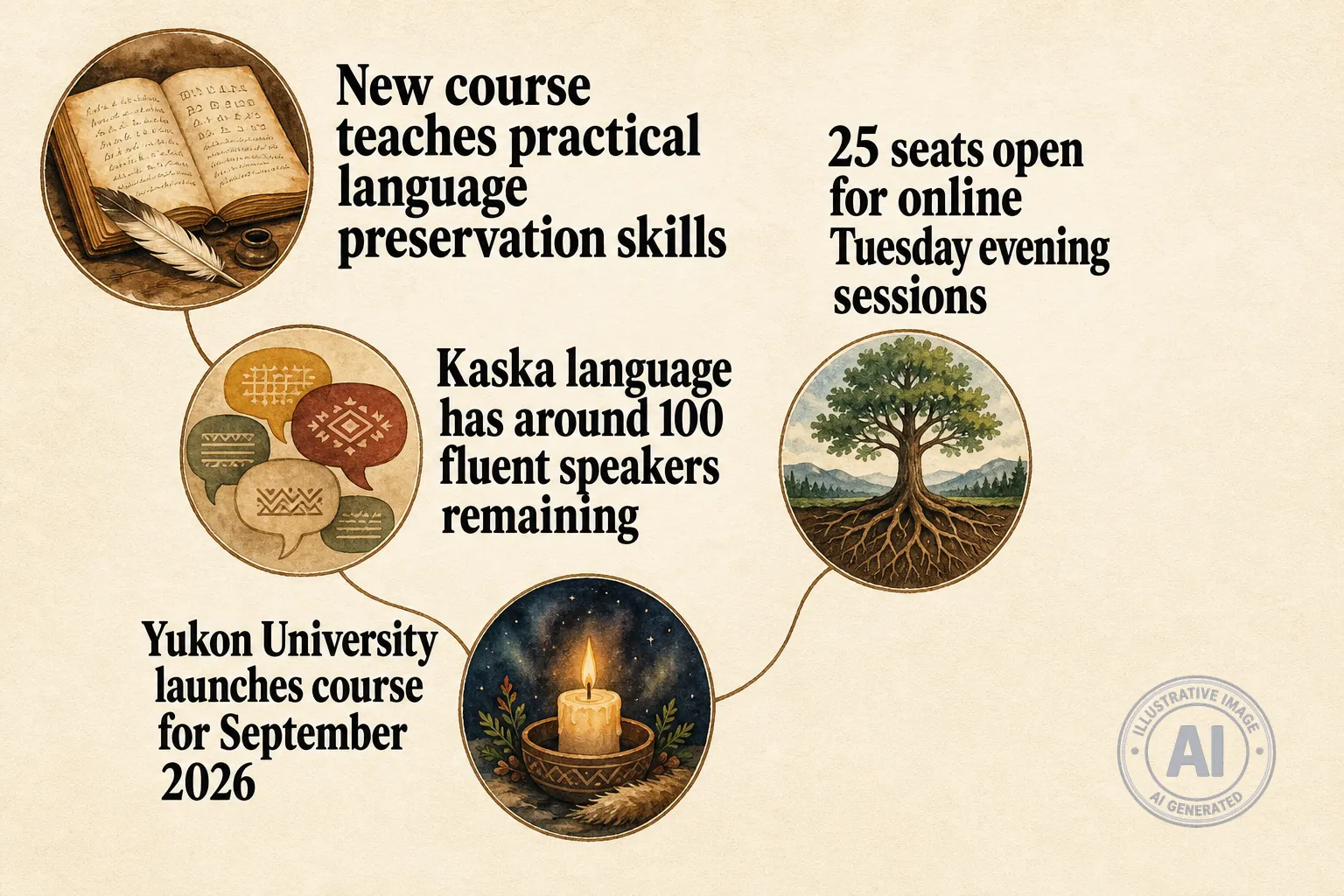
The Yukon University Watson Lake Campus has introduced a new course focused on the preservation and revitalization of Indigenous languages. The three-credit course, titled Language and Culture Preservation, will be available to students starting September 1, 2026.
The course aims to provide practical training in language documentation, including how to use archival materials to build curriculum based on traditional stories, ecological knowledge, and family histories. With 25 seats currently open, the class will be delivered online through live sessions on Tuesdays from 4:00 PM to 5:20 PM. The course is led by Amanda Graham, who serves as the Chair of the School of Social Sciences and Humanities at the university.
This initiative arrives as the community works to protect the Kaska language, which currently has approximately 100 fluent speakers remaining across the territory. Watson Lake, which is situated within the Traditional Territory of the Kaska people and serves as home to the Liard First Nation, has been a focus for broader revitalization efforts. In February 2024, the Government of Canada announced a $1.8 million investment over five years to support Kaska language programs in the area.
Residents interested in learning more about the course or enrolment details can contact Michelle Collins, the Community Adult Education Coordinator for the Watson Lake Campus, at 867-536-8800 or by email at [email protected]. The campus continues to provide distance learning and educational resources to support the needs of local First Nations and community organizations.