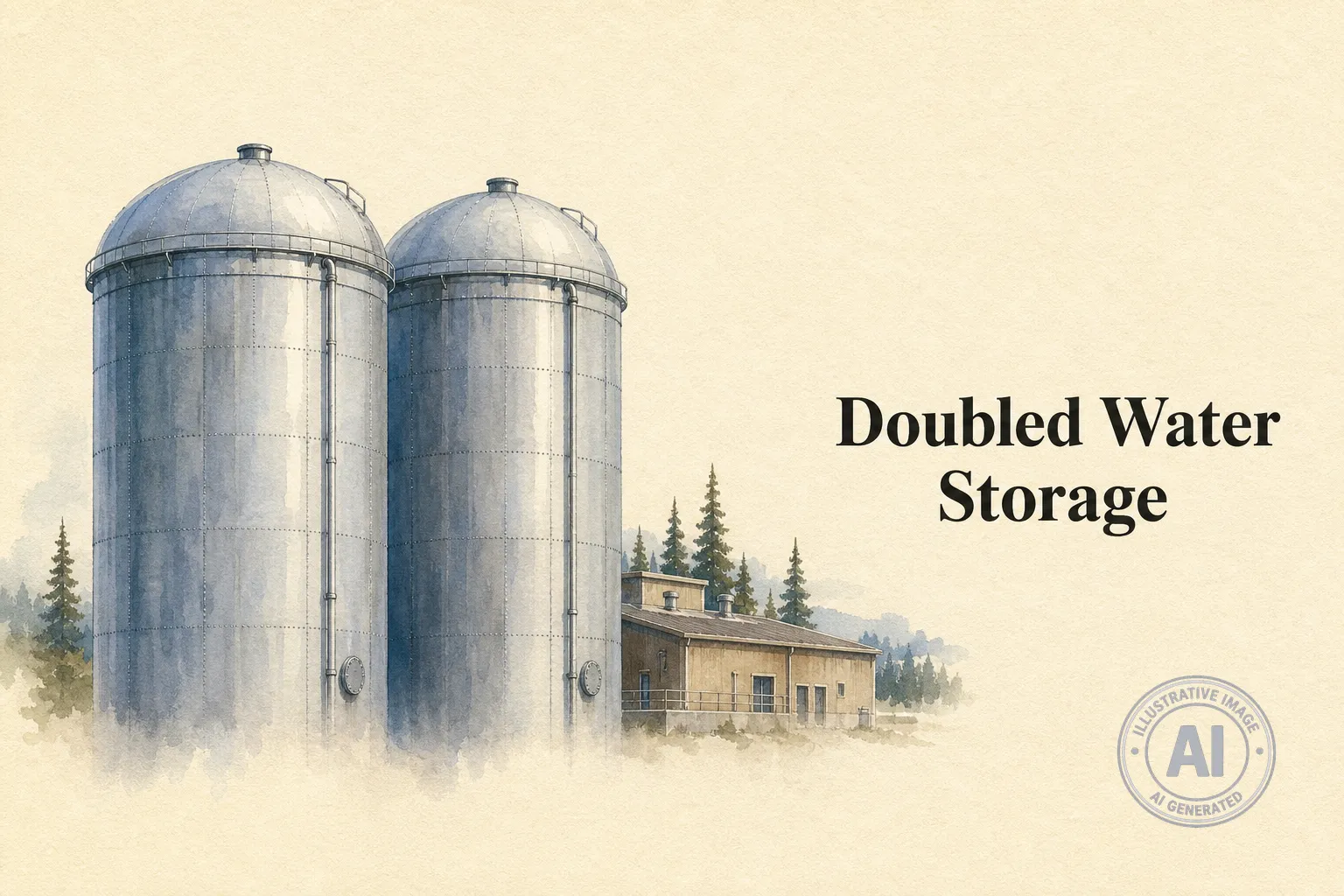
Dawson City, Yukon, has finished building two new drinking water reservoirs, doubling the community’s water storage and strengthening firefighting capabilities. The project, announced as complete on July 30, 2026, adds more than 3.6 million litres of capacity and replaces aging infrastructure from 1978.
The $10.53 million project was funded through the Investing in Canada Infrastructure Program, with $7.35 million from the federal government and $3.18 million from the territorial government. The new reservoirs sit at the corner of Dugas Street and Fifth Avenue, right across from the community’s water treatment plant that was completed in 2019.
Mayor Stephen Johnson called the modern infrastructure a milestone for the community. “Their completion strengthens our community’s fire response capacity and supports long term public safety,” Johnson said. “We are grateful to the governments of Yukon and Canada for their investment in the long-term health, safety and growth of Dawson.”
The reservoirs can sustain a constant flow of 185 litres per second for five hours during a fire, enough to protect major buildings like the new hospital and seniors residence. This upgrade comes after a tough start to 2026, when a two-week water system failure in January led to boil water advisories and school closures, highlighting how badly the old setup needed replacing.
Yukon Minister of Community Services Cory Bellmore noted the project’s role in keeping pace with Dawson City’s needs. “A growing community like Dawson City needs to have modern infrastructure to support it,” she said. Dr. Brendan Hanley, MP for Yukon and Parliamentary Secretary to the Minister of Northern and Arctic Affairs, stressed the federal commitment to resilient northern communities.
The town, home to roughly 1,900 people, sees its population nearly double in the summer tourist season. With the new reservoirs in place, the local water distribution system, which includes 16 kilometres of insulated mains and about 700 building services, is better equipped to handle peak demand and emergencies.