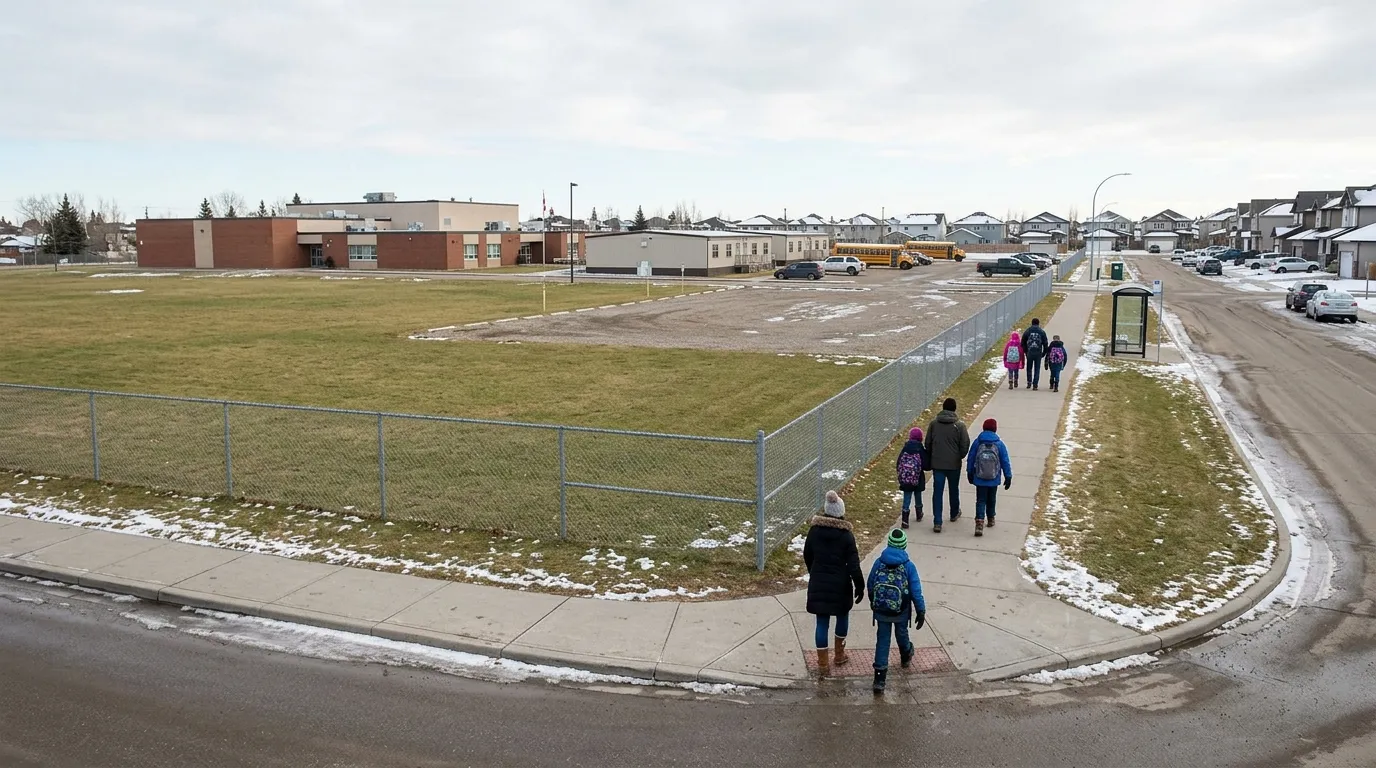
Families in Fort Saskatchewan, Alberta, have moved one step closer to a new school facility after the provincial government officially approved planning funding for a combined junior and senior high school. The Elk Island Public Schools Board of Trustees confirmed the funding during their March 19, 2026, meeting, marking a major milestone for what has been the school division’s top capital priority for years.
The proposed project will replace the aging Fort Saskatchewan High and Rudolph Hennig Junior High by consolidating them into a single, modern campus at the Southridge site. This new facility will serve students in grades 7 through 12 and is designed to accommodate 200 additional student spaces to help manage the area’s rapid growth. As the fastest-growing community within the school division, Fort Saskatchewan has seen its student population increase significantly, while most of its current schools range between 42 and 68 years old.
Beyond traditional classrooms, the new school is planned as a collegiate-style campus. This model aims to offer specialized career streams in areas such as trades, health care, and power engineering. These programs are being developed to align directly with the needs of local employers within Alberta’s Industrial Heartland, where major projects—including Dow’s Path2Zero initiative—are expected to bring hundreds of permanent jobs to the region.
Board Chair Colleen Holowaychuk and Superintendent Sandra Stoddard met with MLA Jackie Armstrong-Homeniuk on March 13 and Education Minister Demetrios Nicolaides on March 18 to discuss the project and next steps. The planning funds are part of the larger Alberta Budget 2026, which includes a record $10.8 billion investment in education across the province.
While this funding allows for the initial stages of architectural design and site assessment, the project represents a significant shift in addressing the infrastructure challenges faced by local families. Fort Saskatchewan High School currently serves over 460 students, and community leaders have long advocated for a purpose-built facility to replace buildings that are nearing the end of their operational lives.