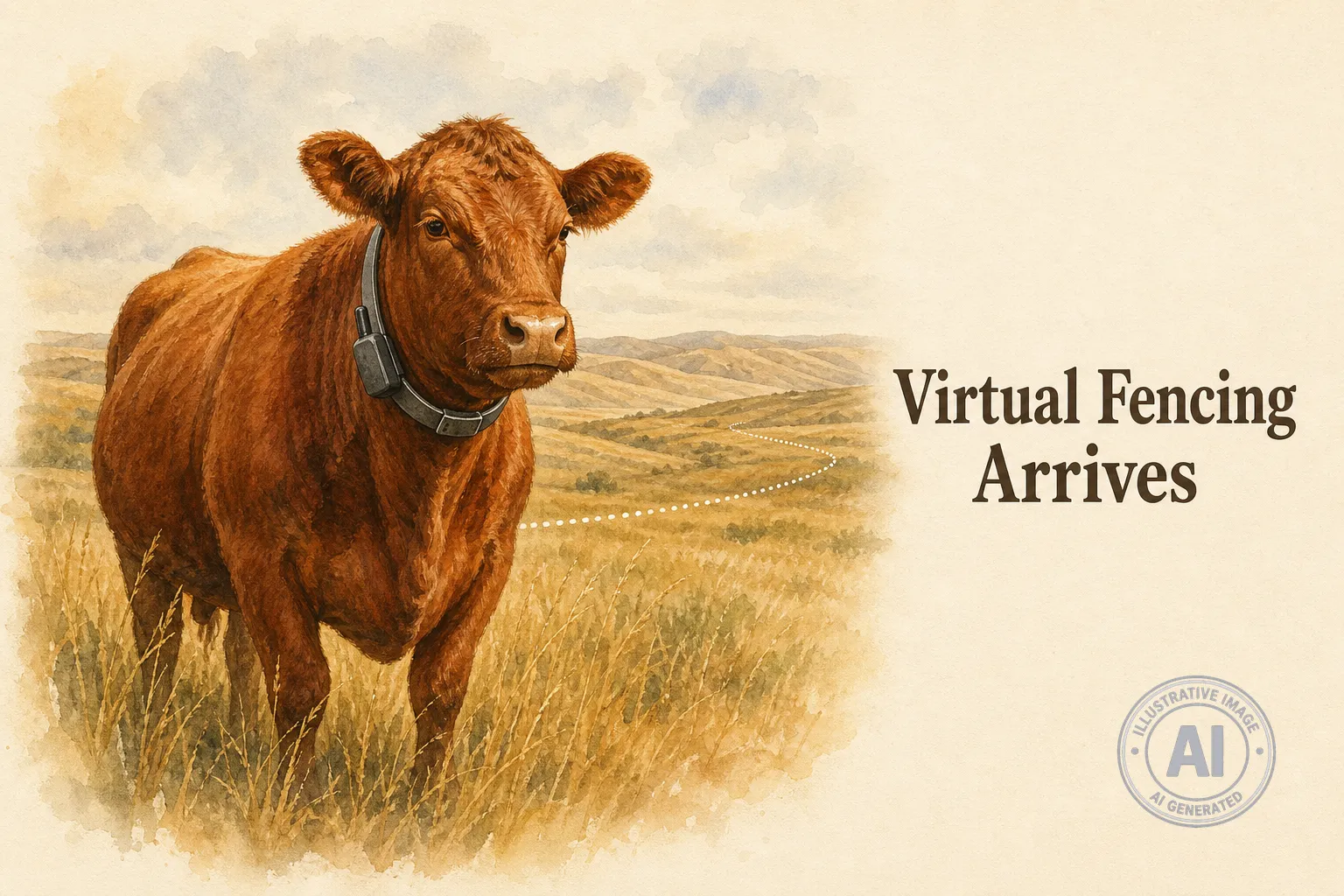
The Technology Access Centre for Livestock Production at Olds College of Agriculture & Technology is the first Canadian research centre to receive and evaluate virtual fencing collars from the New Zealand-based company Halter.
The collars use GPS, audio cues, and mild electrical stimuli to create invisible boundaries that manage cattle movement without physical fences. In Western Canada, this could mean lower fencing costs, less labour for rotational grazing, and the ability to manage cattle in remote or difficult terrain.
This project was made possible by funding from RDAR (Results Driven Agriculture Research), an arm’s-length non-profit created in March 2020 with a $370 million commitment over 10 years from the Alberta government.
To assess the new collar design, collars have been deployed on 80 cow/calf pairs grazed on Olds College land, as well as 35 cow/calf pairs and 35 yearlings at a partner producer’s operation. The research will evaluate how the system performs under Western Canadian conditions, including varied terrain, large pastures, and inconsistent cellular coverage.
Halter’s updated system now includes direct satellite connectivity, eliminating the need for cellular towers or Wi-Fi infrastructure previously required. The company recently raised $220 million USD in Series E funding at a $2 billion valuation, one of the largest agtech funding rounds globally.
University of Alberta research has shown cattle respect virtual fence boundaries more than 99% of the time, with yearlings learning the system within five to seven days and remembering it the following year.