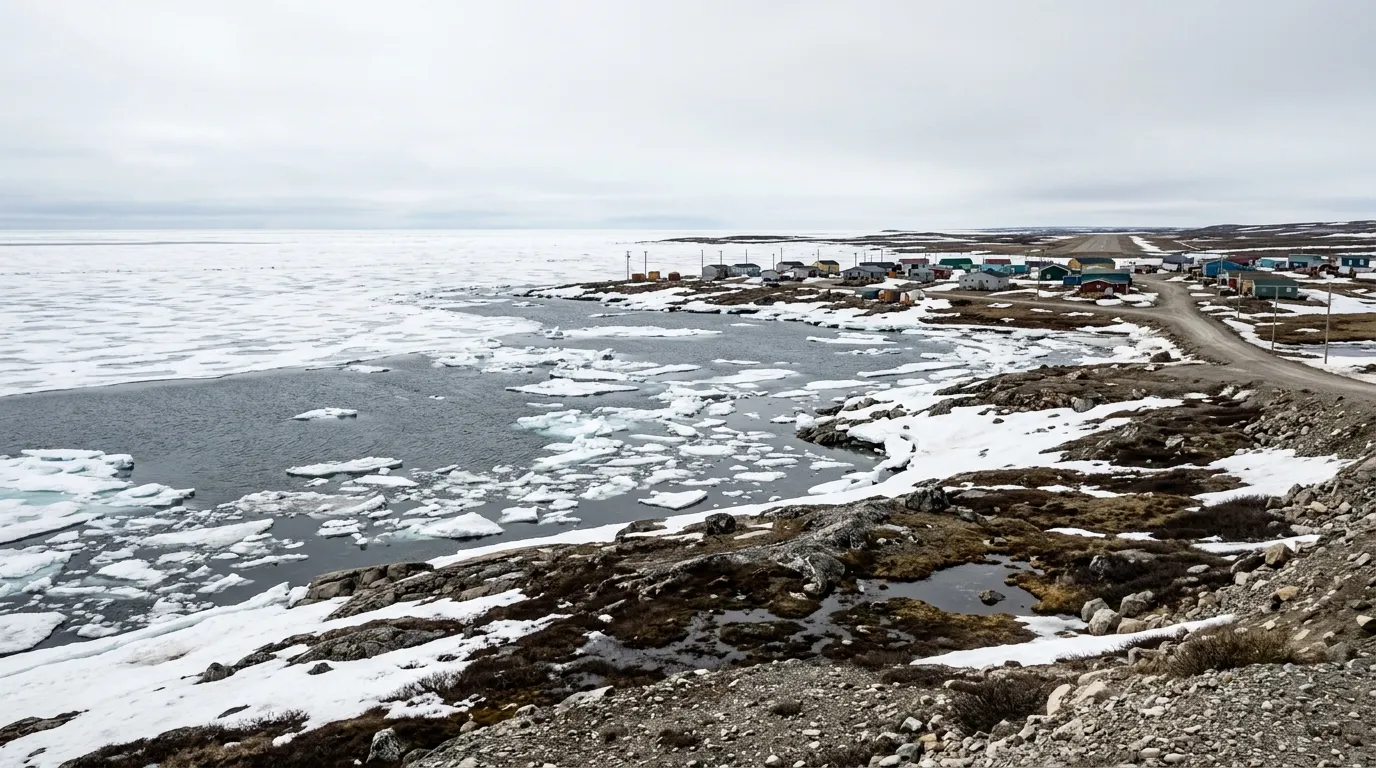
Spring has arrived in Rankin Inlet, Nunavut, bringing the start of the annual sea ice breakup in Northern Hudson Bay. As temperatures rise, residents are preparing for the seasonal shift that impacts how goods and supplies move in and out of the community.
The Canadian Ice Service updated its regional ice charts on April 6, 2026, confirming that the seasonal breakup is underway. This period marks a transition for the community, as ice in the region typically begins to thin and decay through early May. Historically, Hudson Bay reaches its maximum ice coverage between January and March before entering a thawing period that usually leaves the bay ice-free by August.
For the residents of Rankin Inlet, which is the second-largest community in Nunavut with a population of 2,975 (as of the 2021 census), this time of year highlights the community’s dependence on air travel. Because there are no all-season roads connecting Rankin Inlet to other parts of Canada, the community relies on airplanes as the primary mode of year-round transportation. During the summer open-water season, residents also depend on sealift shipping coordinated from locations like Montreal or Churchill, Manitoba.
This ongoing challenge of isolation has driven interest in a proposed all-season road project. A feasibility study finalized in July 2025 by the Government of Nunavut, with support from Transport Canada, outlines a 725-kilometre highway connecting Rankin Inlet to neighbouring communities including Arviat, Whale Cove, Chesterfield Inlet, and Baker Lake. Planning for this project, which has an estimated construction cost of $3 billion, remains in the advanced stages.