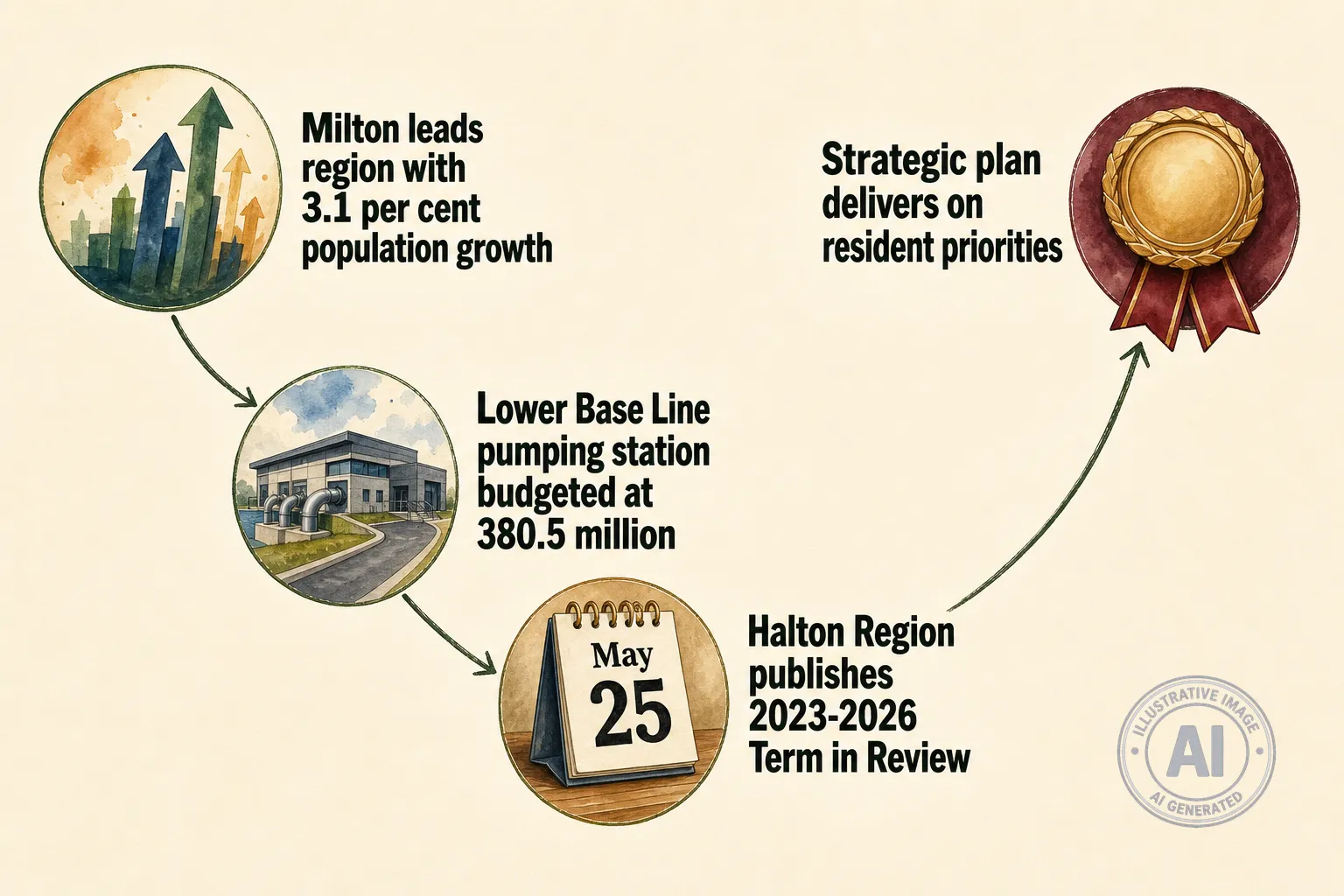
Milton, Ontario residents can now read or watch a four-year review of the services, growth management and spending decisions that shape their daily lives after Halton Region published its 2023-2026 Term in Review on May 25, 2026. The report was presented to Regional Council on May 20, 2026, and outlines what the upper-tier municipality achieved for its more than 650,000 residents across Burlington, Halton Hills, Milton and Oakville.
The document shows that Milton continues to be the area’s fastest-growing town, recording a 3.1 per cent population increase from 2023 to 2024 while the rest of the region grew at 1.9 per cent. That pace puts Milton on track to reach a projected 355,000 residents by 2051, and the report points to several infrastructure projects designed to support that influx.
A focal point for Milton is the Lower Base Line Wastewater Pumping Station, which carries a budget of $380.5 million. The station is part of a $1.18 billion capital program for 2026 that will also tender 30 kilometres of wastewater mains, 26 kilometres of watermains, 30 kilometres of roadways, five pump stations and nine treatment plants across Halton. Beyond the immediate work, the Region identified $5 billion in infrastructure needs between 2031 and 2051 and has a growth-related financing program that supports roughly 30,000 new housing units.
Halton Regional Chair Gary Carr said the term’s work reflects what residents said they wanted. “Our Strategic Plan is based on what our residents told us matters most and we have delivered on those priorities. Halton Region has a proven track record of making smart investments in critical infrastructure and providing reliable services residents depend on every day, while servicing growth and keeping tax increases as low as possible,” Carr stated in the report. Chief Administrative Officer Andrew Farr credited staff for advancing the region’s priorities.
The review also notes that Regional property tax increases averaged 2.0 per cent between 2014 and 2026, a period during which Halton maintained its top credit ratings of AAA from S&P and Aaa from Moody’s. Other highlights include a Halton Region Corporate Climate Action Plan that aims to bring corporate emissions to net-zero by 2045, already reducing greenhouse gas output from Halton Community Housing buildings by 28 per cent. On the community side, the Region added 339 new assisted and supportive housing spots, Paramedic Services handled more than 66,000 calls in 2025, and it expects nearly 20,000 licensed child care spaces under the Canada-Wide Early Learning and Child Care system by the end of 2026.
The full Term in Review is available as a PDF on Halton’s website, alongside a summary video.