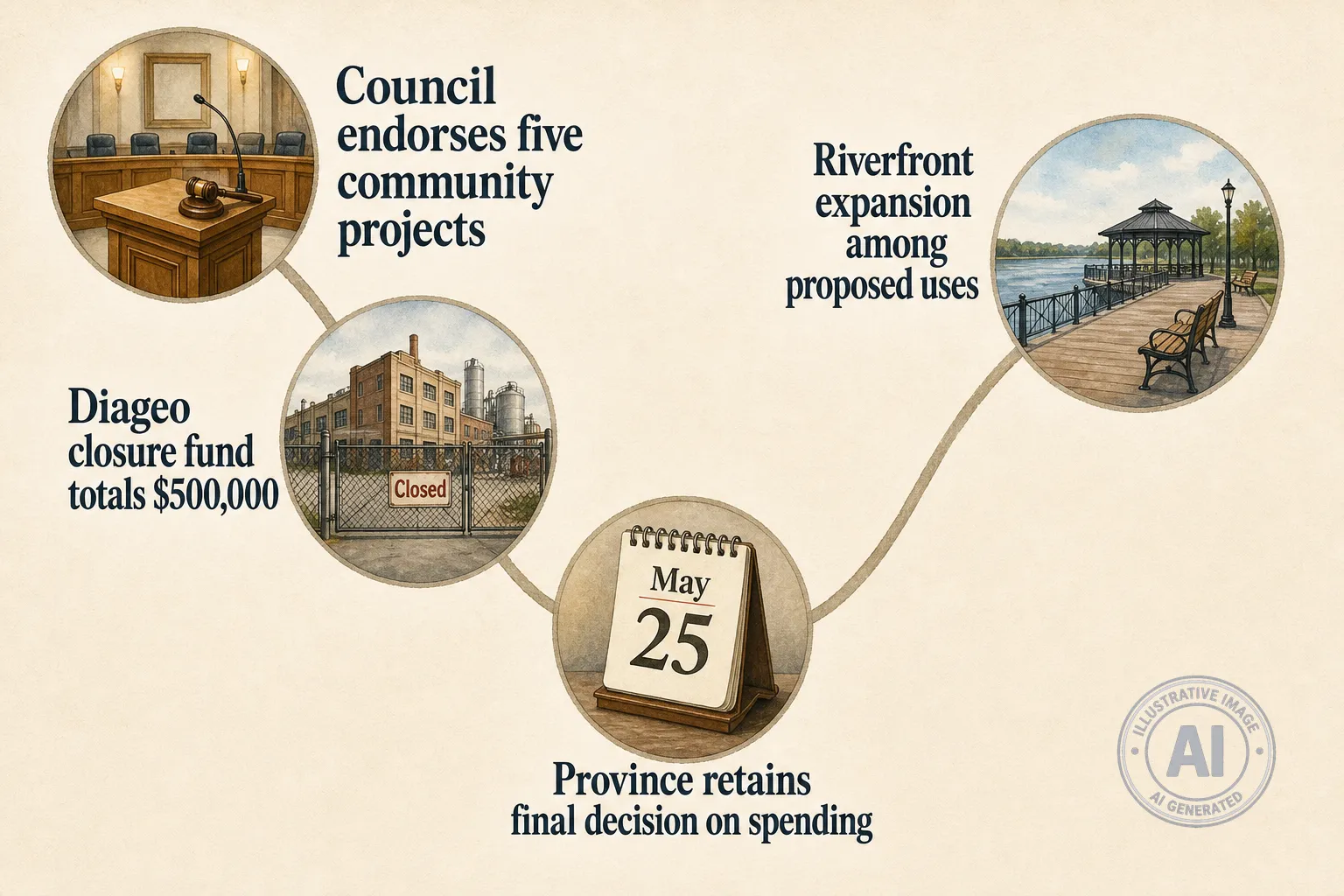
Amherstburg town council has endorsed five possible community projects to receive roughly $500,000 in Diageo funds tied to the Crown Royal plant closure, but the final decision rests with Diageo and the provincial government, councillors learned at a May 25, 2026 meeting.
The five options include expanding the riverfront with new amenities, donating the full amount to Amherstburg Community Services, making annual charitable donations of $60,000 over eight years, creating a $100,000 bursary for local students at St. Clair College, and extending Balaclava Street North through the former Diageo property. Council can only recommend how the money is used, leaving some officials and residents frustrated.
The funds are part of a $23 million deal struck between Ontario and Diageo in February 2026 after the company shut down its Amherstburg bottling plant, eliminating about 160 unionized jobs at what had been the town’s largest employer for more than five decades. The agreement kept Crown Royal on LCBO shelves but directed only $500,000 to Amherstburg for community projects, with another $500,000 going to Invest WindsorEssex for economic development.
Mayor Michael Prue has called the Amherstburg share “about two per cent” of the total deal and believes only the riverfront expansion clearly fits Diageo’s funding criteria. Deputy Mayor Chris Gibb called the situation “insulting” and later wrote that council should decide based on what is best for Amherstburg rather than have to “seek the approval of a multinational corporation that turned its back on our town.”
Former Diageo employee Nicolette Dufour, who worked at the plant for 41 years, urged council to support Amherstburg Community Services, noting that the workers’ job losses made the funding possible. “A number of retirees have made suggestions as to where the money would have the best impact,” Dufour said, adding it was “wrong” that council lacks the final say.
A staff report presented at the meeting restricts the use of the funds to tourism, economic development, and arts, culture and heritage. The money cannot be used for health care, advocacy or lobbying, religious organizations, or youth services.